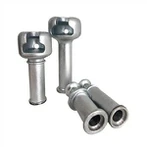
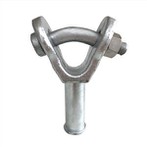
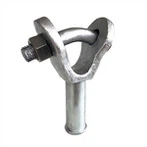
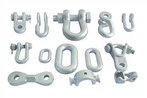
Post insulators are a special insulation control that can play an important role in overhead transmission lines. In the early years, pillar insulators were mostly used for telegraph poles. Slowly, a lot of suspended insulators were hung on one end of the high-voltage wire connecting tower. It was used to increase the creepage distance, usually made of silica gel or ceramic, called insulators. Insulators play two basic roles in overhead transmission lines, namely supporting wires and preventing current from returning to the ground. These two roles must be guaranteed.
Insulators should not fail due to flashover breakdown caused by changes in the environment and electrical load conditions, otherwise the insulators will lose their function, which will damage the use and operating life of the entire line. A lot of disk-shaped insulators are hung on one end of the high-voltage wire connecting tower, which is to increase the creepage distance, usually made of glass, ceramic or rubber, called insulators. In order to prevent contamination such as floating dust from adhering to the surface of the insulator, a path is formed and is broken down by flashover at both ends of the insulator, that is, creepage.
Therefore, increase the surface distance, that is, the creeping distance, and the distance of discharge along the insulating surface, that is, the leakage distance is called the creeping distance. Climbing distance = surface distance / the highest voltage of the system. According to the degree of pollution, the crawling distance is generally 31 mm/kV in heavily polluted areas. The zero-value insulator refers to an insulator whose potential distribution at both ends of the insulator is close to zero or equal to zero during operation.
The influence of zero or low-value insulators: The insulation of line wires depends on the insulators, due to manufacturing defects or external effects, such as dirty surfaces of the insulators, lightning strikes, etc. The insulation performance of the insulator will continue to deteriorate. When the insulation resistance decreases or becomes zero, it is called a low-value or zero-value insulator. Insulators are smooth and can reduce the capacitive reactance between wires to reduce current loss.